|
I'm going to speak about
what the art of acting says about marriage, including mistakes wives
make. The biggest mistake, Aesthetic Realism taught
me, is for a
woman to give way to her desire to be scornful and superior, to have
contempt—for her husband and the world. This takes many everyday
forms, all debilitating, all ruinous. And it's amazing that every one
of these forms has its likeness to mistakes in acting. This is what I
have the pleasure of showing technically tonight.
1. Their Purpose Is the Same
Marriage, Eli Siegel explained, is "a means
for liking the world." It is a means for a woman and man to have,
as he once said to me, "the most accurate and romantic relation with
the universe possible." He also taught me—and this changed the whole
direction of my life—that acting has the very same purpose. Acting is
a means, through one's self, one's thoughts, speech, one's body—of
being fair to the selves of other people, characters in plays, getting
inside of them, becoming them. The art of acting, therefore, is a
making one of the opposites of self and world, point and expansion,
being affected and affecting. As Mr. Siegel said in the lesson we just
heard "[It]is a way, of being somebody else," of taking
"a trip in order to find out who you are. When you act, he said, "You
are trying to meet [a character] accurately and merge with
it." Isn't that what every wife is hoping to do?
Yes, because
when we marry we're looking to have our intimate, personal self become
at one, respectfully, lovingly with a man who comes from and represents
reality. A woman needs to feel: "I want to be fair to the depths
of this man, his thoughts, his hopes, his fears, his memories, his
relations. Just as an actress tries to imagine what a character
was doing before the play began, I want to see who this man was before
I came on the scene, not just as a featured player in my drama."
But when
a woman has contempt, when she uses her
husband, as Mr. Siegel showed me in a lesson I was in danger of doing
with the man I would marry, Sheldon Kranz, not to like the world, but
"just for myself" to serve me, and make me the most important thing in
the universe" she becomes bitter with her husband and the world, and
then asks herself "What went wrong?"
In issue 1305 of The Right Of,
titled "Poetry,
Domesticity, Love," Chairman of Education Ellen Reiss explains:
A wife, who now feels
her marriage is flat,...does not see that the
reason is: she has used her husband...not to know the world in its
wideness and care for it, but to make less of it. She thought,
when they married eight years ago, that romance was their ability to
kick out the world together, make a universe apart, and feel the two of
them were superior to everybody. What she saw as romance was
really contempt, the most hurtful thing in the human
mind....
And when a wife
has used her husband to kick out the world-she
inevitably wants to kick him out, too, and finds various ways of
showing her superiority. So, we come to an immemorial mistake in
marriage and acting:
2.
Upstaging--a Bad Relation of Point and Expansion
A heinous thing in any theatrical production—and a constant danger for
a wife—is what is called "upstaging." In marriage it occurs like
this: You, the wife, out at a gathering or with friends, arrange by
various means—some subtle, some not—to have your husband in the
background, or even offstage in the wings, while you take center stage,
and all eyes are focused on the main character in this drama. The
opposites of self and world, point and expansion or circumference are
painfully awry.
Upstaging in the
theatre occurs when, during a
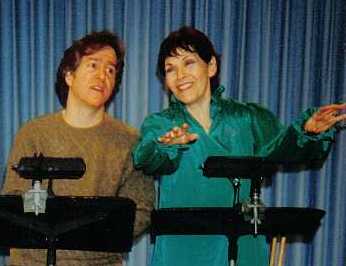
dialogue between two people, you move upstage, like this: [Example, AF moves to center back on the
stage]
forcing the other actor gradually to move downstage. Now this
might not seem so bad, because you tell yourself he's closer to the
audience—but, the whole purpose is to have him turn towards you so his
back, not his expressive face and eyes, is what the audience sees,
while you remain center stage, the spotlight on you. An example,
here is a brief dialogue from Act I of An Ideal Husband by Oscar
Wilde. [BC and AF go to stage
right.]
Bennett
Cooperman is
Sir Robert Chiltern, and I am Gertrude, his wife:
Sir
Robert. How beautiful you look to-night,
Gertrude.
Lady
Chiltern. [AF
moves to center upstage as she speaks and BC is forced downstage,
turning towards her.] Robert, it is not
true, is
it? You are not going to lend your support to the
Argentine speculation? You couldn't!
Sir
Robert. (starting) Who told you I
intended to do so? [His back is now
to the audience.]
Lady Chiltern.
That woman who has just gone out, Mrs. Cheveley,
as she calls herself now. Robert, I know this woman. You
don't. We were at school together. She was untruthful,
dishonest, an evil influence....
Another
form of upstaging is for an actress to do superfluous activities during
a scene, distracting the audience, making them pay attention to her,
not the other actors or the unfolding plot. For example, there is what
is called "furniture grabbing," something I did in one of my first
acting jobs in summer stock, during a mystery play. The audience was
tense, wondering "What's going to happen next? Who's the murderer?" [AF demonstrating]. And
there I was, clutching the back of the sofa, wiping the table with
quiet intensity—[BC rise and start
emoting]—while the actor playing my husband was speaking some
of his most important lines. The director was tearing his hair out,
furious—let alone my fellow actor—this was utterly unprofessional,
and I was lucky I wasn't fired!
This has its humor,
but it's ugly and anti-art; it arises from unkind competition with a
husband and the world. Women try to upstage their husbands in all
kinds of ways; as a means of showing that she's the center of the
universe, superior to everyone and everything—and it makes her mean.
I'll give a few
examples, using my own experiences as a wife: Upstaging occurs when
your husband calls to tell you something that happened he's excited by,
and you're hurt—why didn't he ask you about your day and all the
unpleasant things you had to deal with? And if, at a party, he's
having a good time talking with people, you either wangle the
conversation around to something you simply must express—as we say in
the theatre "pad your part"—or sulk alone in a corner, getting
everyone to worry about you. And at home, when he's concentrated on
work he is doing, you bustle around, vacuuming loudly, doing the dishes
noisily, or as I'm sorry to say I did, try to engage him in discussion
about the urgent matter of what you should prepare for dinner, or his
opinion of the skirt you just bought.
"Can your desire
to control Sheldon be inordinate?" Mr. Siegel once asked me. Yes,
it was. And if a husband has a concern, a wife pleasantly but
dutifully asks him a few questions—and then moves on to the more
important character in this play: herself.
For example, in a consultation, Emily
Corrigan of Fairfield, Connecticut told us that her husband, Ryan, was
so worried about losing his job, his stomach was in knots and he was
morose and ill-natured. But as she said this, she sounded peevish,
offended, as if she were the hurt person.
We asked her: "Are you
really interested in knowing what your husband feels, what he's worried
about, how you can honestly encourage him; or do you take it as an
insult that you have to think about him at all?" After all wasn't
she the star of this show?
Mrs. Corrigan
was thoughtful. She told us that as a young woman, "I felt I should
just get praise and devotion from a man I was dating, and that I needed
to be the center of attention at all times. If he talked to
someone else or had anything to do with other people, I became angry
and aloof."
In a lesson, Mr. Siegel once
asked me at a time I was displeased because my husband was giving his
thought to something important "What is your biggest desire, to have
Sheldon honor you or be sincere with himself?"
This is also a
question that can be asked of an actress—Do I want my fellow
performers to make me shine, or be as good as they can be?
3.
How Well Do We Listen; or, Affecting and Being
Affected
In an Aesthetic Realism lesson, Mr. Siegel
said to me: "Anything, including listening, can have the word art
before it. There's an art of skipping rope, and an art of
listening." I want to say that Mr. Siegel himself had that art
consummately.
Onstage there are
various technical showings of faulty listening. There is what is called
"Stepping on another's lines," which means you interrupt a person
before he's finished his sentence—and it's seen as reprehensible and
unprofessional. Wives are notorious for this—and what it comes from in
both instances is contempt, the false importance we get from
diminishing others.
Here is an example. In
Act I of Sheridan's The School for
Scandal—a husband, Sir Peter Teazle and Lady Teazle are
quarreling about the way she spends money; a frequent subject of
marital fights. 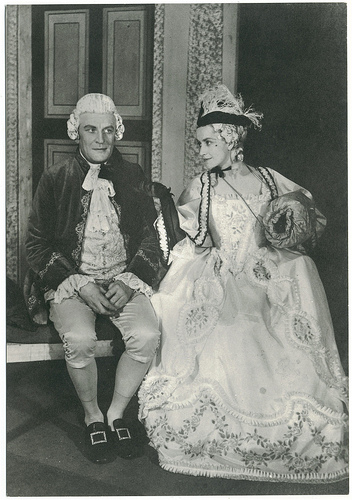 The scene begins, "Enter Sir Peter and Lady
Teazle"—and first, we'll read it straight: The scene begins, "Enter Sir Peter and Lady
Teazle"—and first, we'll read it straight:
Sir Peter.
Lady Teazle, Lady Teazle, I'll
not bear it!
Lady Teazle.
Sir Peter, Sir Peter, you may bear it or not,as
you please; but I ought to have my own way in everything,
and what's more, I will, too. What! Though I was educated
in the country, I know very well that women of fashion in London are
accountable to nobody after they are married.
Sir Peter.
Very well, ma'am, very well;—so a
husband is to have no influence, no authority?
Lady Teazle.
Authority! No, to be
sure:—if you
wanted authority over me, you should have adopted me, and
not married me: I am sure you were old enough.
Now, here is what would happen if, because I haven't
really been listening to him, I step on Sir Peter's lines: [Example of stepping on lines,
interrupting—BC and AF do scene.]
Another mishap
as to listening is coming in late on cue, or forgetting your lines
altogether. How often has a wife "dropped her cue," as her
husband tries to tell her something, or asks a question. She'll take a
long pause, be distracted, her mind on something else? This is
what it would sound like:
[Example of coming in late on cue, long pauses. BC begins on "Very
Well, Ma'am...."]
As an example of
how important listening is in the theatre, I quote from an article of
1916 by the critic Arthur Johnson, titled "Sarah Bernhardt Here Again,"
on the occasion of the great actress's second visit to the U.S. He
writes:
As
the audience was dispersing, an actor exclaimed,... "Heaven's, what a
wonderful feeder!" "Feeding," as it is technically called, is another
name for the difficult art of listening, or paying the
closest sort of attention to the actors with whom the scene is
played....Bernhardt is never above listening--with rapt attention--to
whatever is said to her by the actors on the stage. And it is
this quality, more than anything else, that has made her a permanent
favorite with American audiences.
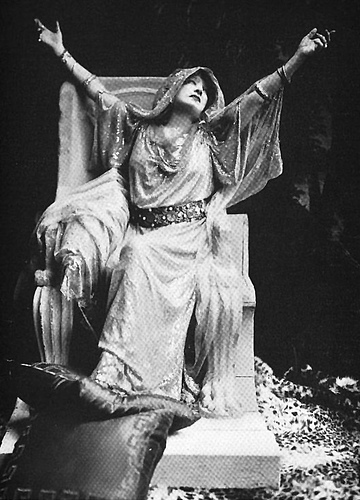
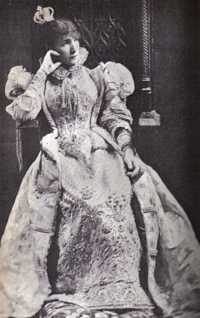
Here is the "Divine Sarah"—[on left, Sarah Bernhardt in
Racine's Phedre]—the actress
who has been seen as so dazzling—[on right, Bernhardt as the Queen in
Victor Hugo's Ruy Blas]—and
this critic says what makes her great, is how well she put together affecting
and being affected; how well she listened to her fellow actors, which
made the audience listen keenly, too. Every wife can learn from this.
4.
Overacting; or "Tearing a Passion to Tatters"
In Hamlet's famous Speech
to the Players, Act III,
Scene 2, he advises them not to overact, saying: "But if you mouth it,
as many of our players do, I had as lief the town crier spoke my lines.
Nor do not saw the air too much with your hand, thus, but use all
gently."
Hamlet, Mr. Siegel explained in The
Right Of—is
asking for aesthetics. And in a class, he looked at these lines,
and said: "When you mouth something, there is more energy than is
necessary—and also you are louder than you have to be. And a [certain
kind] of gesture [sawing the air with your hand] is also
excessive." How many wives, in
kitchens and bedrooms, use their
energy this way—as a weapon, to defeat a husband, make him cower,
subdue him? Hamlet tells the Players not to "tear a passion to
tatters....Pray you avoid it."
Overacting in the
theatre has always
been seen as
reprehensible; made fun of—and the reason is audiences feel, rightly,
it's insincere, fake stuff. "The test of sincerity," Mr. Siegel
explained, "is whether there is a right involvement with the depths of
yourself, the self as individual and the world as such, let alone
things." When an actress over-emphasizes, "rants and
raves," her purpose is to have a big effect, to show how passionate she
is—usually to cover the fact that she has so little real
feeling—there is not that "right involvement with the depths of
herself and the world as such."
And when
a wife says,
melodramatically: "What do you
want from me!" or, "I asked you to bring lemons, not limes, you idiot!"
"You're killing me!"—she is insincere and ungraceful Her purpose
is unaesthetic and mean; she doesn't give a damn about her effect on
her husband; in fact, with all her seeming agony, she's contemptuously
calm inside, and is having a terrific triumph wiping the floor with
him, all to prove the world is against her. Then, she feels awful.
I learned about this
danger in a
lesson early in my
marriage. When Sheldon told of my getting intense about a
domestic situation, and later berating myself, Mr. Siegel explained:
"You use yourself dramatically. Your mistake is to use intensity for
despair. At a certain point it is intelligent to mute the drama and let
it speak for itself. You don't know how to be prosaic."
This was the very problem I had as an actress! A frequent
criticism I heard was that my acting was too intense, 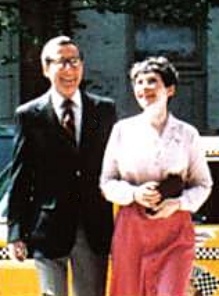 overblown, but not deep enough—and I had a tendency to
turn each
scene—be it a comedy or straight drama—into very high tragedy. overblown, but not deep enough—and I had a tendency to
turn each
scene—be it a comedy or straight drama—into very high tragedy.
"How are you on the
middle register?"
Mr.
Siegel asked me in one lesson. "Do you welcome all possibilities of
acting, or do you prefer the defiant or the despairing?" "I do,"
I said, and he showed me the danger, saying: "These two moods have to
be added to, or in real life you're going to do one or the other—the
smelling salts or stamping your foot." And he said:
The main problem a
person has, married or unmarried, is the problem of
opulent sincerity. In marrying Sheldon, you're using his problems to
understand your own. Do you think you're up to that? One aspect of
sincerity is an undiminished, untiring desire to find out what you feel.
I love him for these words,
and see them as useful to every wife. They
also point to another constant danger in marriage and acting.
5. What Happened to Romance; or, the
Feeling of the First Time
In TRO 1305, under the heading "Familiarity
and Wonder in Marriage," Ellen Reiss answers that question as she
writes about what wives all
over America feel:
The man whom they
once saw as Mr. Romance, who
brought to the tedium of life a something that made their hearts leap,
is now a husband; and instead of offsetting the tedium, he now seems to
be part of it, to add to it.
And she explains:
Meaning, wonder, real
romance, real thrill are the feeling that the world itself is close to
us through another thing or person. That is so in art.
When I read these
sentences, I thought about what
called in the theatre "the feeling of the first time." which
Stanislavsky, the great Russian director and theoretician went for very
much. It has to do with freshness, seeing new meaning, wonder in
lines you may have said many times, and saying them with such sincerity
and naturalness that they seem to come from you, at that very moment.
When this occurs on the stage, it's very exciting.
A wife needs
to see a husband with that true wonder; not succumb to the contempt
that says: "I know my husband like a book." She needs to see the man
she's close to the way Miranda does in Shakespeare's The Tempest, when
she says, looking at persons for the first time:
O,
wonder!
How
many goodly creatures are there here!
How
beauteous mankind is! O brave new world
That
has such people in't!
Said Mr. Siegel in his great lecture on the play: "[Miranda] has her
sense of wonder, she has the artist's unstained eye, and unpolluted
perception, and unblemished heart." This is good will; it is what
every wife and every performer needs—and Aesthetic Realism can
teach us to have that beautiful purpose.
* * *
|
|